
The science
The discovery that inspired byMae
Fast immune cells can learn after all.
Your immune system has a slow side that remembers and a fast side that scientists thought couldn’t. Here’s what they found.
- 1 / 5
T cells start slow and remember for years. They are part of your adaptive immune system.
Doc T: “Memory’s my department.”


- 2 / 5
Innate cells act fast. Textbooks said they had no memory.
Mighty Mac: “I just react.”


- 3 / 5
In a lab dish, scientists gave beta-glucan from yeast to innate cells for one day.
Mighty Mac: “Wait, I can learn this stuff.”
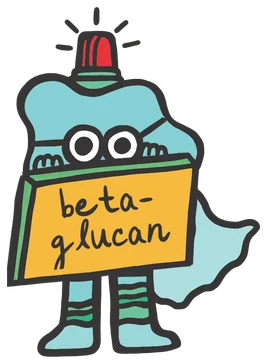
- 4 / 5
A week later in the dish, the cells responded more readily to something new.
Captain Ready: “Same Mac(rophage), only readier.”



- 5 / 5
Scientists named it trained immunity in 2011. It lasts weeks to months.
Doc T: “Memory was supposed to be my department.”
- 1 / 5
T cells start slow and remember for years.
Doc T: “Memory’s my department.”
- 2 / 5
Innate cells act fast. Textbooks said they had no memory.
Mighty Mac: “I just react.”
- 3 / 5
In a lab dish, scientists gave beta-glucan from yeast to innate cells for one day.
Mighty Mac: “Wait, I can learn this stuff.”
- 4 / 5
A week later in the dish, the cells responded more readily to something new.
Captain Ready: “Same Mac(rophage), only readier.”
- 5 / 5
Scientists named it trained immunity in 2011. It lasts weeks to months.
Doc T: “Memory was supposed to be my department.”
Your immune system has two sides. The innate side, your first line of defense, acts within minutes to hours. The adaptive side takes days to get going, then remembers specific invaders for years.
For more than a century, scientists believed only the adaptive side could remember. Then researchers found the innate side can learn too: after certain exposures, its cells respond faster and more strongly the next time.
Dr. Mihai Netea’s group at Radboud University named this trained immunity in 2011. It overturned a textbook rule and is now studied in labs around the world. Netea won the 2016 Spinoza Prize, the highest science award in the Netherlands.
His research inspired byMae and our mission to make proactive immune health part of everyday life.
You might know the name from your skincare.


Beta-glucan
Beta-glucan (bay-tuh GLOO-kan) is a natural fiber from baker’s yeast. Your innate immune cells recognize its shape, which is why beta-glucan has been studied so extensively in immune research.
Read about beta-glucan →What the research found in adults
Beta-glucan supports your body’s front-line immune function.*

Double-blind, placebo-controlled · Frontiers in Physiology, 2017 · Read the study →
See all the research ↓Each person took 250 mg of beta-glucan a day for 10 days and a placebo for 10 days, in random order. Then they ran 90 minutes of treadmill intervals in a room set to a heat index of 124°F (51°C). Blood was drawn four times.
| Blood draw | Placebo | Beta-glucan |
|---|---|---|
| Before exercise | Starting level | Starting level |
| Right after | Rose slightly | Rose slightly |
| 2 hours after | 23% below starting level | No net change |
| 4 hours after | 29% below starting level | No net change |
The paper gives no figure for the rise right after exercise, so the chart plots the before, 2-hour and 4-hour draws. The cells counted are monocytes, front-line immune cells in the blood.
What about kids?
Beta-glucan has been studied in children as well. One trial, published in 2016, gave 174 children aged 1 to 4 in Beijing either baker’s yeast beta-glucan or a placebo for 12 weeks. A 2021 review of 34 trials of beta-glucans from yeast and mushrooms included six in children, and none of the 34 reported side effects caused by the beta-glucan.
More on beta-glucan and kids ↓K-beauty made maintenance normal: care for something before there’s something to fix. That same instinct shapes how we think about immunity.

Immunity Training, built into your daily multivitamin.
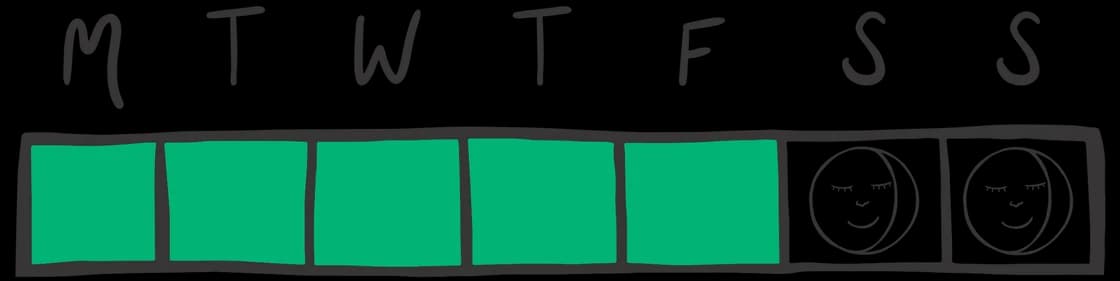
If you miss a day, pick it up on the next weekday. There’s nothing to make up.
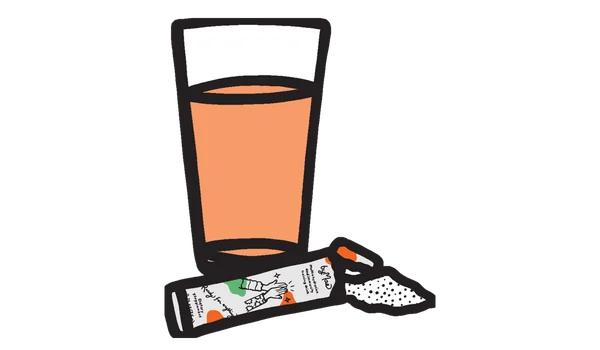 byMae multi+ for adults Drink
 byMae multi+ for adults Capsules
 byMae multi+ for littles Chewables, ages 2+
Immunity Training is our practice for proactive health and immunity, built around a simple idea: have a foundation in place before you need it.
multi+ combines daily essentials with clinically studied beta-glucan and follows a weekdays-on, weekends-off routine.
It’s inspired by the award-winning science of trained immunity, which changed what scientists know about the innate immune system’s ability to remember.
Questions
Trained immunity is a kind of memory scientists found in the innate immune system, your first line of defense. Dr. Mihai Netea’s group at Radboud University named it in 2011, and research since then has looked at how innate immune cells respond differently after an earlier encounter.
Trained immunity is the science: a kind of memory scientists found in the innate immune system. Immunity Training is our practice, built around a simple idea: have a foundation in place before you need it. multi+ combines daily essentials with clinically studied beta-glucan and follows a weekdays-on, weekends-off routine, and we named that routine after the science of trained immunity.
Innate immunity is your body’s fast first response to anything unfamiliar. Adaptive immunity is slower and targets specific invaders. Trained immunity research found a kind of memory on the innate side too.
Beta-glucan supports your body’s front-line immune function.* Beta-glucan (bay-tuh GLOO-kan) is a natural fiber from baker’s yeast. Your innate immune cells recognize its shape, which is why beta-glucan has been studied so extensively in immune research.
A 2021 review of 34 randomized trials of beta-glucans from yeast and mushrooms, taken at up to 1,000 mg a day for up to six and a half months, recorded no side effects caused by the beta-glucan. If you’re pregnant or nursing, we’d hold off on multi+ for adults. Check with your doctor first if you’re being treated for a condition or take medication.
Most research on yeast beta-glucan has been in adults, and some trials have been in children. One trial, published in 2016, gave 174 children aged 1 to 4 in Beijing either baker’s yeast beta-glucan or a placebo for 12 weeks. A 2021 review of 34 trials of beta-glucans from yeast and mushrooms included six in children, and none of the 34 reported side effects caused by the beta-glucan. multi+ for littles hasn’t had a study of its own. If you’re considering it for your child, show your pediatrician the label.
No. multi+ hasn’t had a clinical trial of its own, and no study has measured trained immunity in people taking multi+ or its beta-glucan. The study in the chart gave adults beta-glucan by itself, and the comic shows lab work with beta-glucan from a different yeast. Every batch of multi+ is tested before release.
The research
These are the main papers behind this page, and most are free to read in full.
In people
Front-line immune cells in 109 adults after a hard workout in the heat
McFarlin et al. · Frontiers in Physiology · 2017
Read the paper → (opens in a new tab)34 trials of yeast and mushroom beta-glucans, six of them in children
Vlassopoulou et al. · Food & Function · 2021
In the lab
The receptor immune cells use to recognize beta-glucan
Brown and Gordon · Nature · 2001
Summary on PubMed → (opens in a new tab)How a beta-glucan’s shape and size change what it does
Han et al. · Frontiers in Immunology · 2020
Read the paper → (opens in a new tab)The paper that named trained immunity
Netea, Quintin and van der Meer · Cell Host & Microbe · 2011
Read the paper → (opens in a new tab)How immune cells trained in a dish use fuel
Cheng et al. · Science · 2014
Read the paper → (opens in a new tab)The DNA packaging of immune cells trained in a dish
Saeed et al. · Science · 2014
Read the paper → (opens in a new tab)